
Peace Pedalers
- Author(s):
- Lauren Mari-Navarro, Caitlin Churchill
- Issue:
- Fire (July 2026)
- Department:
- Interviews
This interview, which was edited for length and clarity, is the second in a three-part series on a bike trip for peace that took place in 1982. Paul Jolly, who had the initial impulse for the trip, was interviewed in the previous issue. Jonathan Vogel, who also participated in the trip, will be featured in an upcoming issue.
Caitlin: Can you give me an outline of the trip and the people involved?
Lauren: There were six of us total: three men and three women. Our trip focused on disarmament and making people more aware of the concerns surrounding nuclear war. We wanted to give people a sense of how prepared the world was 44 years ago to destroy itself very quickly. It’s still not a popular topic to talk about, especially with the fire hose of events we’re experiencing right now. Something as important as a nuclear threat doesn’t even hit the collective bucket list of public conversation.
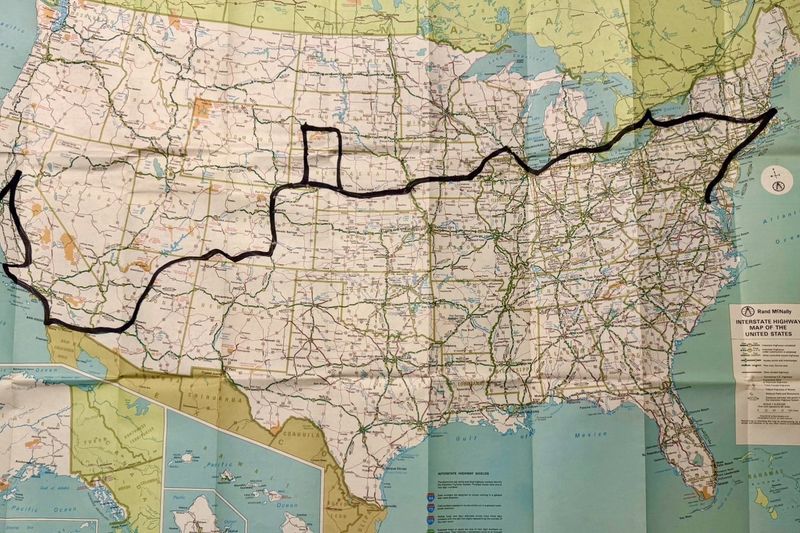
The early 80’s was a period of developing national awareness of the threat of nuclear weapons. We were in Yuma, Arizona, during Ground Zero Week, which was a national project to promote awareness of the dangers of nuclear catastrophe. Later, when we were in Kearney, Nebraska, right in the middle of Middle America, Paul wrote that we heard the first reports from people returning from the June 12th rally in New York, which celebrated the opening of the United Nations Special Session on Disarmament. That was a major event happening in 1982, and it was one of the reasons we were traveling at that time.
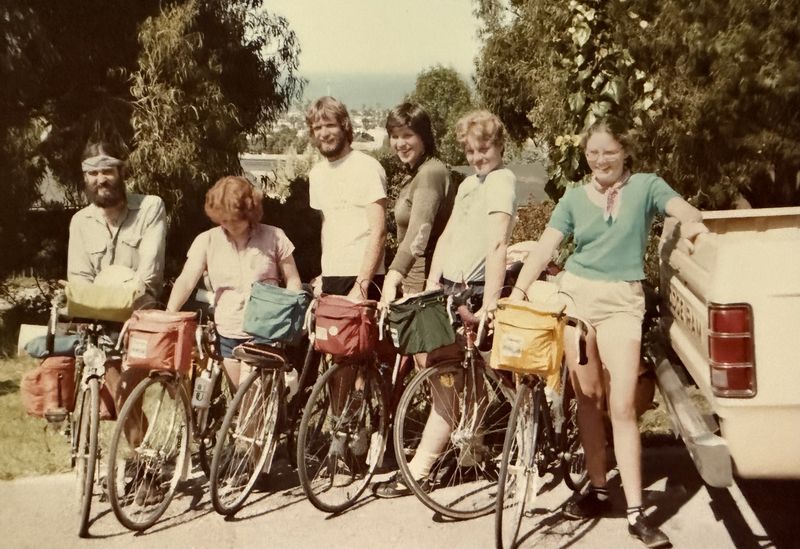
We were looking forward to a global conversation regarding the importance of a collective will to slowly disarm, rather than a unilateral disarmament. We spoke to church groups, military personnel, community groups, and educational groups ranging from young children to college students. We also visited many Quaker meetings and attended lots of Quaker potlucks. Eventually, we hit a bit of a desert for Quaker presence because there were very few Friends meetings in the Midwest at that time. We were supported by many others in the anti-nuclear peace movement and were welcomed to their local efforts. Our aim was to make it to Washington DC by October.
I’m thankful that we didn’t have modern technology, smartphones, or recording equipment outside of a Minolta camera. The lack of devices allowed us to be fully engaged and present in the moment. We were completely out of touch with everyone else because calling home required finding a phone booth for a long-distance call. It made our community much more condensed; our only familiars were each other.
Caitlin: Can you talk about the joys and challenges of the journey?
Lauren: The physical endurance required for a 5,000-mile bicycle trip across the country is an immense challenge, especially since we were completely packed out with gear. Jonathan carried a violin, Paul Jolly carried a typewriter, and I carried a journal, which was much lighter than a violin or a typewriter!
People often ask if we had a road crew or a ground crew, but we didn’t have anything like that. It was moving to meet people who were genuinely grateful for what we were doing. They would tell us they couldn’t make such a journey themselves and were glad we were doing it on their behalf. Even back then, people would press 10 and 20-dollar bills into our palms to support our journey. We felt deeply held by our home communities that organized fundraisers for us, as well as by the people we met along the way who were touched by our message.
Navigating physical endurance was constant, as was living continuously with five companions who held different points of view and preferred different daily mileage targets. This was somewhat contentious, especially at the beginning of the trip since we all had different levels of physical endurance. Back then, there wasn’t a great deal of training prior to the cross-country trip. Our trip was focused on our mission and activism rather than feats of physical heroism. You just got on your bike, and the trip itself became the training that built your endurance.
I remember being bone-tired during those first few days. It took some time for your rear end to get used to the bicycle saddle. But at age 23, your body adapts quickly. Beyond the physical endurance, the community process required a lot of communication. Because we were Quakers, we held lots of meetings to reach consensus regarding our plans and schedules. We were a loving community, but we were also a source of occasional irritation to one another. Ultimately, our bond was strong. Some of us remain engaged in one another’s lives over the decades since the trip.
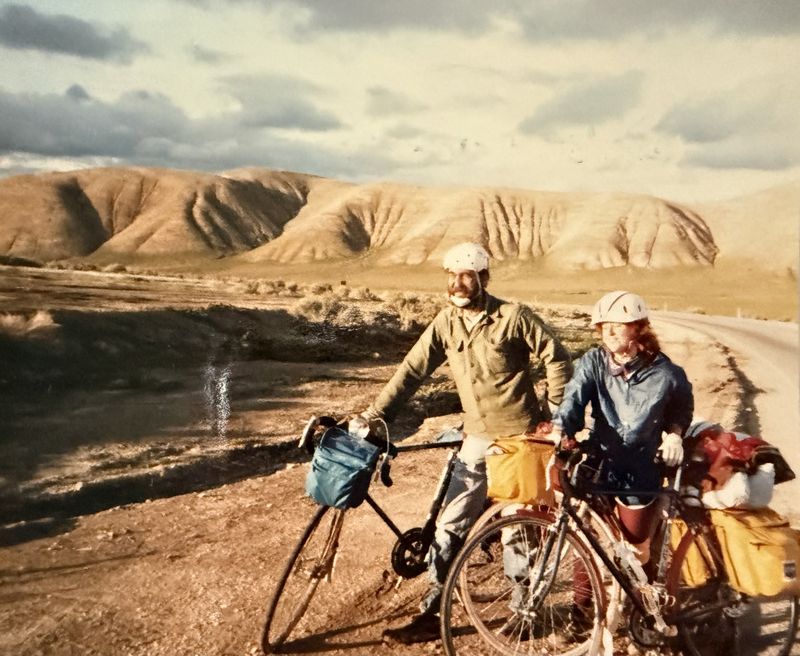
It’s difficult to narrow down the joys because the eight-and-a-half-month trip was so packed with events. We moved constantly from one engagement to another. There were speaking opportunities with schools and churches, TV, radio and newspaper interviews, and events such as parades and even opportunities to receive blessings. In Wisconsin, a Catholic church held a peace event where they prayed for us at a very large mass, and a group of Catholic sisters in New Mexico invited us to be the central focus of a peace parade in their small town. Despite the awkwardness of all eyes upon us, we rarely declined an offer to support a local effort to build awareness. So many things happened that it’s impossible to capture the immensity of hundreds of extraordinary experiences that happened on nearly a daily basis.
The deepest joy was connecting intimately with the American people and having fascinating conversations with them. On one occasion, I was riding my bike and encountered another woman on a bike who designed and developed nuclear weapons. She told me she felt proud of her work to make the weapons cleaner and safer, which struck me as an oxymoron. We had a poignant back-and-forth conversation as we rode alongside each other. It was just happenstance, but it was a striking juxtaposition of entirely different viewpoints. We encountered that dynamic in several places where our message wasn’t welcome or understood, but we still tried to bridge the gap by finding what we had in common.
Caitlin: What inspired you to join the Peace Pedalers trip?
Lauren: I was a student at UC Santa Cruz and took a course titled the Psychology of Death and Dying. One unit of the course examined the dangers of nuclear war. The professor did not hold back about the horrific consequences. My student friends and I didn’t sleep for days because it was so terrifying. I felt a deep fear regarding what our country was preparing for.
That experience inspired my activism which was also supported by our local meeting and the Resource Center for Nonviolence in Santa Cruz. Jonathan and I participated in a weekly peace vigil at the town clock downtown every Wednesday afternoon, a vigil that went on for a number of years.
In March of 1981, a member of the meeting named Ian Thierman offered to drive me to a three-day conference called The Medical Consequences of Nuclear War, which was sponsored by the Physicians for Social Responsibility. Expert testimony from physicians such as Helen Caldicott described a medical community completely unprepared to treat victims who might survive the aftermath of an attack. Documentary-maker Eric Thierman recorded the conference and then edited to recording over several months, creating an award-winning one-hour video. The video was a major catalyst for the disarmament movement. We carried copies of The Last Epidemic: The Medical Consequences of Nuclear War in our panniers and showed it to many groups along the way. This was before digital technology, so setting up video screenings required coordinating audio equipment and TVs with our host groups. In our project newsletter, titled Second Wind, Jonathan or Paul wrote about the challenge of using the video; it was nightmarish and terrifying, leaving people with a sense of disaster. We had to balance that fear by facilitating discussions centered on hope and our positive vision for the world.
That conference catapulted my concern. When Paul Jolly from Strawberry Creek Meeting said, “I have this dream of doing a bike trip across the country,” I initially thought it was a crazy idea. But I noticed a few other Friends were also interested, and I started to get excited about the project. I became convinced that Paul’s dream might be the perfect avenue for me to take my activism to the next level and engage everyday Americans who didn’t realize how extensively we were stockpiling weapons that could end everything. I had completed my undergraduate degree in psychology but was working as a bank teller and cleaning my professors’ houses, which wasn’t very interesting. I admire my young self for just going for it, because it’s a courageous thing to step into the complete unknown.
At that time, there was also a grassroots movement called Beyond War. Everyday middle-class citizens were educating themselves about the nuclear arms race and hosting meetings in their homes to envision a world without war. My commitment to the trip came from a combination of that college course, the conference, and a desire to channel my activism into a positive project.
While specific daily memories naturally fade after 44 years, certain experiences remain vivid. I remember the moment I tested out whether I could ride my bike across the country—and this is the most foolish thing—I rode my bike out to Davenport, about 10 miles north on Highway 1 towards San Francisco, and back. I did 20 miles total. When I went out there, I walked down to the beach, and that was the pivotal moment for me. That was the moment where I decided to go on the trip, to stop equivocating. The choice felt so big and overwhelming. I told myself, “If the Spirit is going to move me around this or not, I need to know.” I walked up and down the beach asking myself if I should go. I looked out at the waves of the Pacific Ocean and felt a thrill about saying yes to this journey, saying yes to an adventure of a lifetime, even if I had no idea what it would look like.
Caitlin: How did your relationship with the Spirit influence or interact with the journey?
Lauren: The six of us represented a wide spectrum of Quaker theological orientations, similar to what you might find if you went to a modern Western Yearly Meeting. Some members were Christ-centered, while others were more focused on nature and the environment. But because of our shared mission, the journey felt imbued with the Spirit throughout.
Bicycle riding through the Four Corners area was particularly meaningful for me. There are extensive Indigenous lands there, and a few tribes actually invited us to participate in a powwow. We were the only white people present, and it felt like a profound honor to connect over a mutual respect for peace and care for the planet. The landscape of the Southwest possesses an extraordinary spiritual presence. I’m reading a book right now on Celtic spirituality where the author talks about “thin places”—those extraordinary places where you really feel the Spirit. I felt affected spiritually on that land and in that stretch of the ride more than anywhere else in the country.
As a community, we held regular Quaker silent worship together and listened to one another deeply, which welcomed the Spirit into our group. Along the way, we also attended a gathering of the Young Friends of North America, an organization that hosted annual week-long conferences. Surrounding ourselves with Quaker communities naturally deepened the spiritual dimension of the trip. It was the greatest adventure of my lifetime. At the time, I thought my life would be full of epic journeys like this, but an eight-and-a-half-month continuous trek dedicated entirely to activism and living in a spiritual community was not only unique, but transformative.
Caitlin: How did this experience influence you or others over time?
Lauren: Traversing the United States slowly on a bicycle provided an intimate geographical, cultural, and spiritual understanding of the country that is impossible to replicate by car. That experience changed me permanently and became part of my DNA.
The journey also demonstrated what young people are capable of achieving when they unite around a clear mission. It informs the optimism I feel when I look at the millions of young activists organizing today, even when circumstances appear dire. We managed our campaign long before the internet or social media existed. Today’s movements have an immense reach. Knowing what is possible keeps me hopeful that we will see a better day.
In the 44 years since our trip, no nuclear weapons have been used in warfare since the US dropped atomic bombs in August 1945 in Hiroshima and Nagasaki. Our current political instabilities feel like they could bring us closer to this crisis than ever before. The struggle and movement continues toward a peaceable, livable and democratic world.
Caitlin: I would like to understand the structure of your days. Can you walk me through the difference between a travel day on the road and a day spent engaging with a local community? How did you determine your daily mileage and routes?
Lauren: I wonder now at how we trekked 5K miles across the country and did so much outreach. Jonathan compiled a detailed log of our mileage, but to give you a sampling that includes some events and miles, I’ll read you a few entries from very early in the trip:
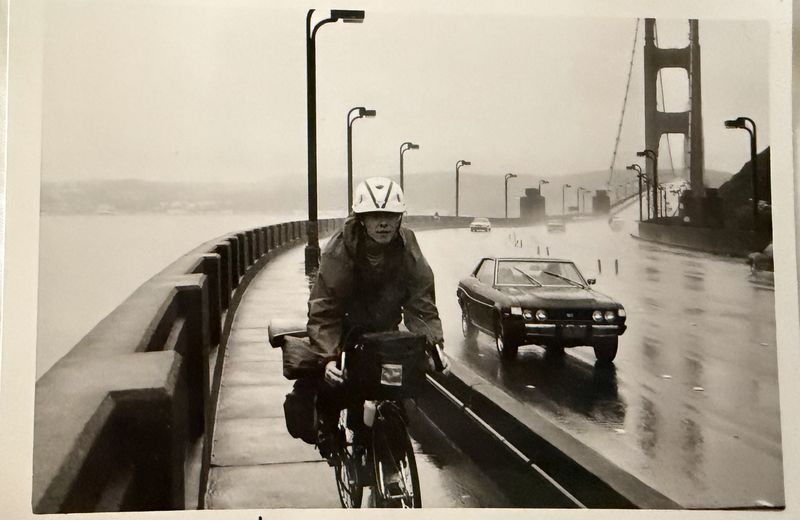
“We departed from the San Francisco Friends Center in heavy rain on March 1st. We rode across the Golden Gate Bridge, arrived in San Rafael, and stayed overnight at a Friend’s house where the Marin meeting hosted an informal potluck for us…On March 6th, we completed a challenging 45-mile ride to the John Woolman School, climbing 3,000 feet in elevation. We were exhausted but enjoyed meeting the students and eating dinner in their cafeteria.
On March 7th, we worshiped with the Grass Valley Friends Meeting and held a well-attended presentation at a high school principal’s home where each member of our group shared their path to peacemaking. Next, we rode 60 miles to Sacramento on International Women’s Day. Caryn, Linda and Lauren rode ahead together to celebrate the special day together.”
Our itinerary fluctuated constantly between strenuous riding days and intensive community engagement. When we weren’t generously hosted by Quakers in their homes, we often slept in church basements, particularly in the Midwest where Quaker meetings were sparse, but our exhaustion made it easy to sleep anywhere. Over time, we learned to manage our rhythm so we didn’t schedule demanding speaking engagements immediately after exceptionally long riding days.
Caitlin: In our previous conversation, Paul mentioned that his refusal to register for the draft disqualified him from receiving student loans, which forced him to leave school. That decision altered his life and created the opening that allowed him to organize this cross-country trip. He mentioned that he preferred this hands-on adventure over a standard office internship.
Lauren: Exactly. We chose a slow, contemplative, and physically demanding journey over localized activism like vigils or letter writing, which we had already done. Given the urgency, we were compelled by the spirit and care for humanity to do more. Arriving in communities that had organized events for us was incredibly fulfilling.
The experience also helped clarify my career path. Within two years of completing the trip, I enrolled in graduate school and earned my Master of Social Work in 1985. The journey inspired my desire to help others in many different ways. It is a career I’ve been engaged with ever since the trip.
Caitlin: Living at that slow but intense pace helped you discover your vocation.
Lauren: Yes, though service was also part of my family background, as my parents were educators who emphasized helping others. The bicycle trip proved to me that I could show up for people effectively. Central to both social work and Quaker tradition is the practice of deep listening. You must listen to people before you can effectively share a message, and the trip reinforced that principle.