
Editorial for Our Beloved Dead
- Author(s):
- Caitlin Churchill
- Issue:
- Our Beloved Dead (September 2025)
- Department:
- Editorials
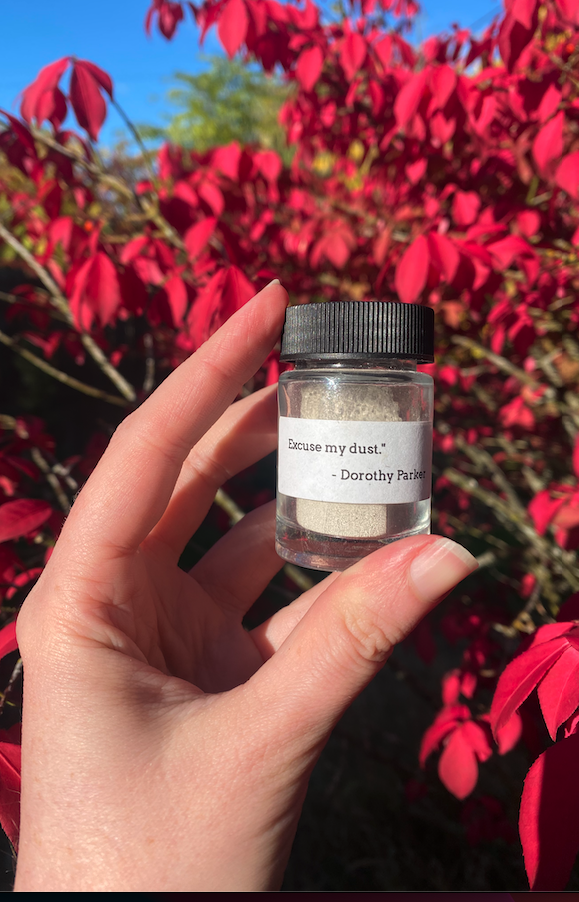
A few tablespoons of my late aunt Jackie’s ashes are in a small glass jar on my desk. They are labeled “Excuse my dust.” quoting Dorothy Parker, per her request. For a while I had them on my bedside table, which my partner was within their rights to oppose. “She seems like she was a nice person but I don’t want to sleep with another entity in the room.”
I put her elsewhere, and one day when going through my crafting box looking for a pencil sharper, I found the small jar of ashes and broke into a combined sob/laugh. I’ve tried to sprinkle her in the redwoods and either forgot or physically could not. Jackie was a writer and editor by profession and was working from home for a long time before it was in vouge to do so. I like to have her around when I’m working. She edited textbooks with the secret mission of instilling a love of words in the younger generation. She was an adult woman with the vibe of a child detective. Endlessly curious, she was going to get to the bottom of life’s mysteries in the kindest and silliest way possible.
Jackie had a commitment to integrity that had her turned firmly against sentimentality and denial. My subconscious has been a big fan choosing to not see the realities of challenging situations. If I’m saying to myself “No, that cannot be so” I might be avoiding the truth.
Jackie accepted the gravity of her diagnoses. By living in reality, she let her family be in reality with her, and allowed the many people she loved to follow along in her process of dying. It was excruciating and yet natural, like trying to watch a solar eclipse without eye protection. As a part of this process, she invited her community to write her emails in her final weeks. She was dying at home in Western Massachusetts and I was living out the pandemic in Salem, Oregon. Jackie wasn’t someone I spent many hours of my life with, but she imbued the moments she was with others with importance and comfort. I would never see her again and I had to tell her what she meant to me. Weeping silently and fighting a shame of honest feelings, I wrote.
Not everyone gets that chance.
In the days after her death, I invited Jackie to take a walk with me down a forest service road. “What’s it like being dead?” I asked and imagined her beside me. “Another angel gets its wings…” she said, rolling her eyes and sighing with both deep exasperation and a sense of levity. Was it my memories of her creating a joke or a genuine expression of her essence? In relationships, we make the ascent to the zenith of emotional intimacy with another person together. The closer to their true essence we get and the more they allow us to see, the deeper the canyon of our grief when they die.
Our beloved dead don’t call and they don’t write and yet the relationship seems ongoing. In this edition of Western Friend we explore our relationships with people who have passed, the process of dying and our own mortality.
I wouldn’t wish the strength I see in seasoned grievers on anyone, and yet death is a promised experience for all beings. I stand in awe of our collective ability to grow in accepting the unacceptable fragility of our lives and the lives of the people we love. Grievers survive a shattering of self and being relegated to a world without a key relationship. Our proprioceptive senses are tuned by the feedback of gravity and pressure. Grievers find themselves without a key form of feedback: who am I without this person, my person? We take the hit of grief in the body and move indelibly away from the moment of earthly connection. The loss of the beloved leads to another insidious loss. Who they were with you specifically and the intricacies of your relationship become a story told in one voice.
This year at Pacific Yearly Meeting Annual sessions, during Meeting for Memorials, the community was led in singing “Swing Low, Sweet Chariot”. Each person sang the same words, not in a round, but in time as they felt called. Each voice shone at a different moment and with various levels of intensity while maintaining harmony. I had never heard anything like it. Yet I could feel resonance with the unconducted symphony of my life: some voices rising strong in one movement but then vanish, while other distinct voices rise up and break through a barrier that I cannot see. There are voices I yearn to hear more from that have long since faded away.
And yet we keep singing.