
Down by the Riverside
- Author(s):
- Rick Seifert
- Issue:
- Rivers (May 2025)
- Department:
- Inward Light
Our lives intersect with rivers in ways we rarely consider. I wrote that sentence under a light powered by the Columbia River.
The river’s hydropower is essential to life on the farms, in our towns, and cities. It drives our economy. It heats homes, powers stop lights, and illuminates classrooms and learning. It powers our cell phone—for better or worse. Its gifts are endless.
We are awed by rivers in valleys, canyons, and waterfalls, but we are blind to vast aquifers that feed the fields and forests linked to harvests and housing.
The waters inspire us: the rapids, the rills, the thundering falls, shimmering water’s course. The rivers’ rush, roar, and whispers give voice to the seasons and the night.
I grew up on a river. Our house was perched on a rise above “Ne-bo-shone”—a sweeping Native American word for a broad “Bend in a River.” Our river’s bend was on the Rock River in Northern Illinois, north of Rockford, where travelers forded the river on rocks. Today, the river is so muddy from eroded farmlands that the rocks are invisible.
Modern lore muses that the murky Rock River is “too thin to plow and too thick to drink.”
In winter, the river disappears under a thick ice blanket, a bridge that lets a boy walk, or, better yet, skate, from shore to shore.
In spring, the ice breaks with creaking and groaning. Occasionally, the river startles with the echoes of colliding sheets of ice.
After the thaw, to the wonder and envy of my friends, I boated to school, persistently pushed by a puttering outboard motor clamped to the stern of a 12-foot-long boat. Some mornings the five-mile river route was shrouded in mist, but even as a lad, I had come to know the river well from languid summers of mist-free navigation.
At the end of my commute, I would tie up under the Auburn Street Bridge, out of sight. Then, still enchanted by the river and mist, I’d stride with a sailor’s pride through the neighborhood to my elementary school.
In summer, I water-skied behind a speeding runabout, jumping its wake and leaning into the slack and pull of the line. Or I’d explore a nearby creek by canoe. Sightings of muskrats, frogs, turtles, and slithering, swimming snakes shaped my youth.
Now, after years in Oregon, I’ve been astonished by our own rivers: The Deschutes, The Snake, The Sandy, The McKenzie, The Rogue, The Clackamas, The Tualatin, The Nehalem, and, of course, The Columbia.
We come to love these and more, yet life has led us to favorites.
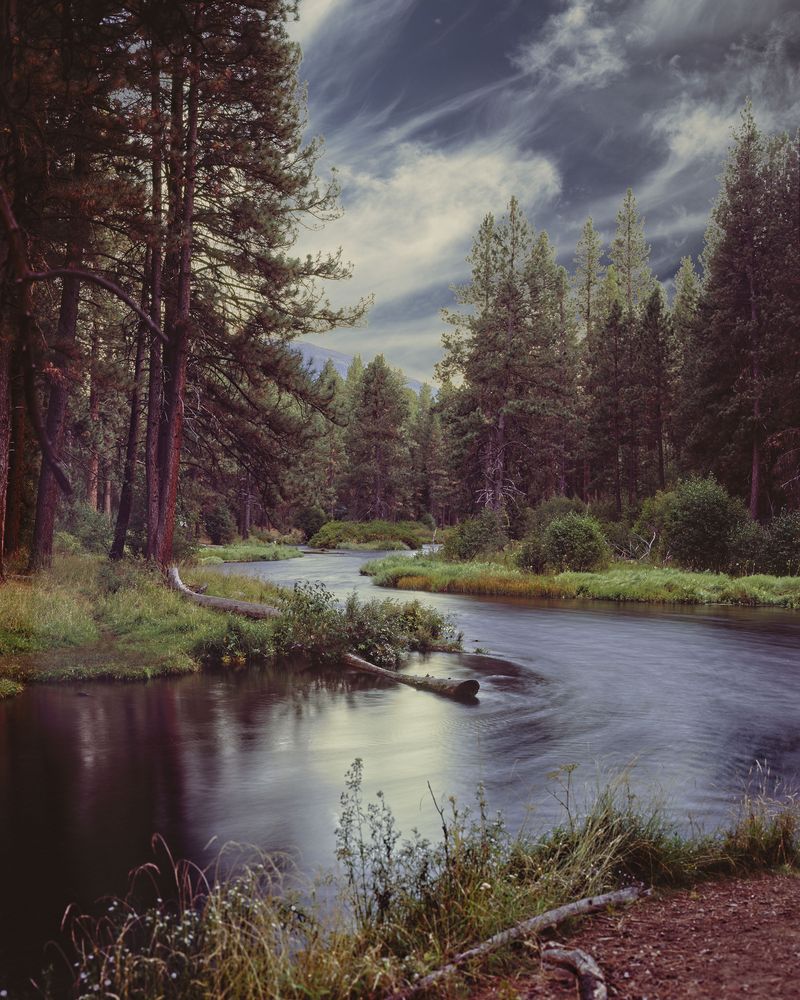
I have been drawn to The Metolius at Camp Sherman. Astonishingly, the river surges whole, pure, and clear, from the base of iconic Black Butte not far from the town of Sisters. The pristine water’s source is underground, hidden in subterranean aquifers crisscrossed by ancient fractures and fissures.
Our rivers, we learn, find their own course below and above ground. Here in Portland, we are accustomed to the sinuous, seemingly gentle Willamette. It is home to herons and eagles, cormorants and egrets, gulls and geese. But in early February of 1996, the Willamette turned dangerous, surmounting its banks and swallowing Willamette Park and its river-tracking Greenway Trail. Armies of volunteers barricaded against floodwaters to protect downtown. Along the Willamette’s flooded length, eight people died.
Water’s wonder also blinds us to the greatest wonder of all: The rivers’ role in the immense, eternal life cycle of water. Like life, its cycle of mystery never ends.
Randomly choose where to join the circle. Why not start in the sky where we now know “atmospheric rivers” flow? Begin in the firmament of majestic cloud.
The stunning rivers of canyons and valleys are mere arcs on a vast circle of cloud, mist, rain, spring, creek, river, and ocean.
Water is spirit—life’s force.
I witnessed it in the Civil Rights movement of the 1960s when we sang of non-violence, of laying down weapons of death—the sword and shield—“down by the riverside.”
Here beside the still waters, we bless new life. Here for thousands of years, the salmon “climb” the waterfalls, and we “harvest” them and give thanks for their life-giving sustenance and inspiration.
Here, down by the riverside, we build our towns and cities, the places we call “home.”
Here, at last, we are learning to protect this circle of water—this gift of life and love.
Here, down by the riverside.
Rick Seifert, a retired journalist, is a former clerk of Multnomah Monthly Meeting (NPYM). While he remains a member of that meeting, eleven years ago, he helped found a small independent worship group, Hillsdale Quakers, in southwest Portland, where he now worships. He works to help unhoused residents of Portland.