
Hand for the Spiritual Body
- Author(s):
- Rob Pierson
- Issue:
- Spiritual Gifts (March 2026)
- Department:
- Quaker Culture
How do our spiritual gifts build community? How does our community nurture these gifts?
These two questions drove the 2016 workshop I led for New Mexico Regional Meeting: The Gifts Among Us: Recognizing the Spirit at work in ourselves and in others.
In the introductory material, I asserted that Spiritual Gifts are:
- Gifts
- From Spirit
- Specific to Us
- For the Benefit of Others
- Interdependent with Gifts of Others
Gifts don’t come from us. Spirit gives to us, and for others. In fact, a good sign of a gift is that it’s one piece that interlocks us into a larger puzzle, or, as St. Paul says, it lets us become a member – like a hand, eye, or foot – in the body of the community. [1.Cor.12:12-26]
A gift may relate to skills we’ve developed, or it may challenge us to develop in ways we never expected. Prophecy is not on most people’s to-do list. We can expect gifts to be mutually supportive, but not alike. The life of a body, or Meeting, depends on people as different as hands, feet, heart, lungs, and bone.
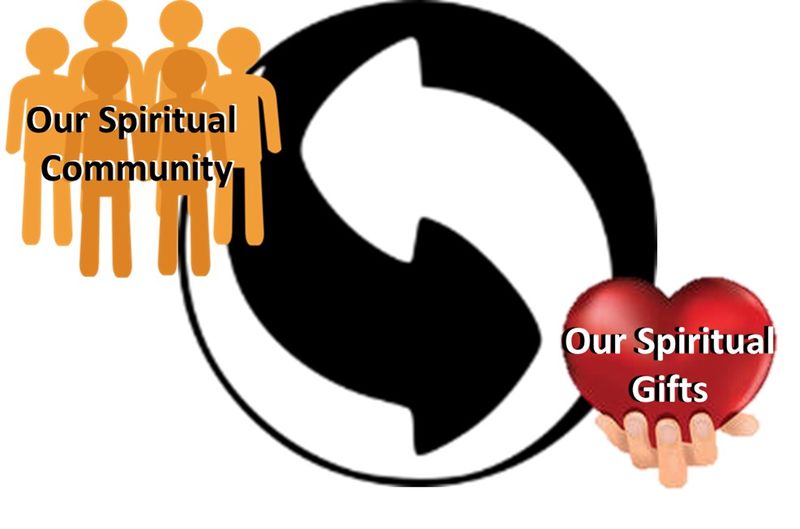
It’s also why community suffers when Spiritual Gifts are neglected, feared, or clustered. For example, we can ignore gifts or hope they’ll go away. Then we may limp along, without the feet we need. Or we can cluster and pile gifts of one type into one basket (i.e. a committee) and somehow expect full spiritual life out of a basket full of feet.
Before the weekend retreat, I posted a set of Spiritual Gifts on the meetinghouse walls. (See list.) My version differed from traditional lists in two ways. First, it uses Quaker-friendly language. For example, “Evangelism” reverts to its original meaning of sharing good news: “You engage with others, sharing what excites you about your faith experience.” Second, I suggest the effect the gift evoke in the community. For Evangelism: “People are inspired to see the Spirit of which your life speaks and join in a spiritual community.”
During the workshop, Friends were given blue, yellow, orange, and pink dots to stick on the wall. A blue dot, meant “this is a gift that we HAVE (you see a lot and admire among Friends).” Yellow meant “this is a gift we NEED (could really use more of among Friends).” Orange meant “this is a gift I WANT,” and pink meant “this is a gift I FEAR (I really don’t want Spirit to give me this gift!)” Friends added dots throughout the weekend as their perceptions changed.
We began the retreat with a simple supper followed by intergenerational art stations. At one station, there were stacks of blank “Gift Tags” – those little paper labels with string attached. Throughout the weekend, these tags represented our Spiritual Gifts. “If you are the gift, what would be your label?” If you aren’t sure, ask others what they see as your gift!
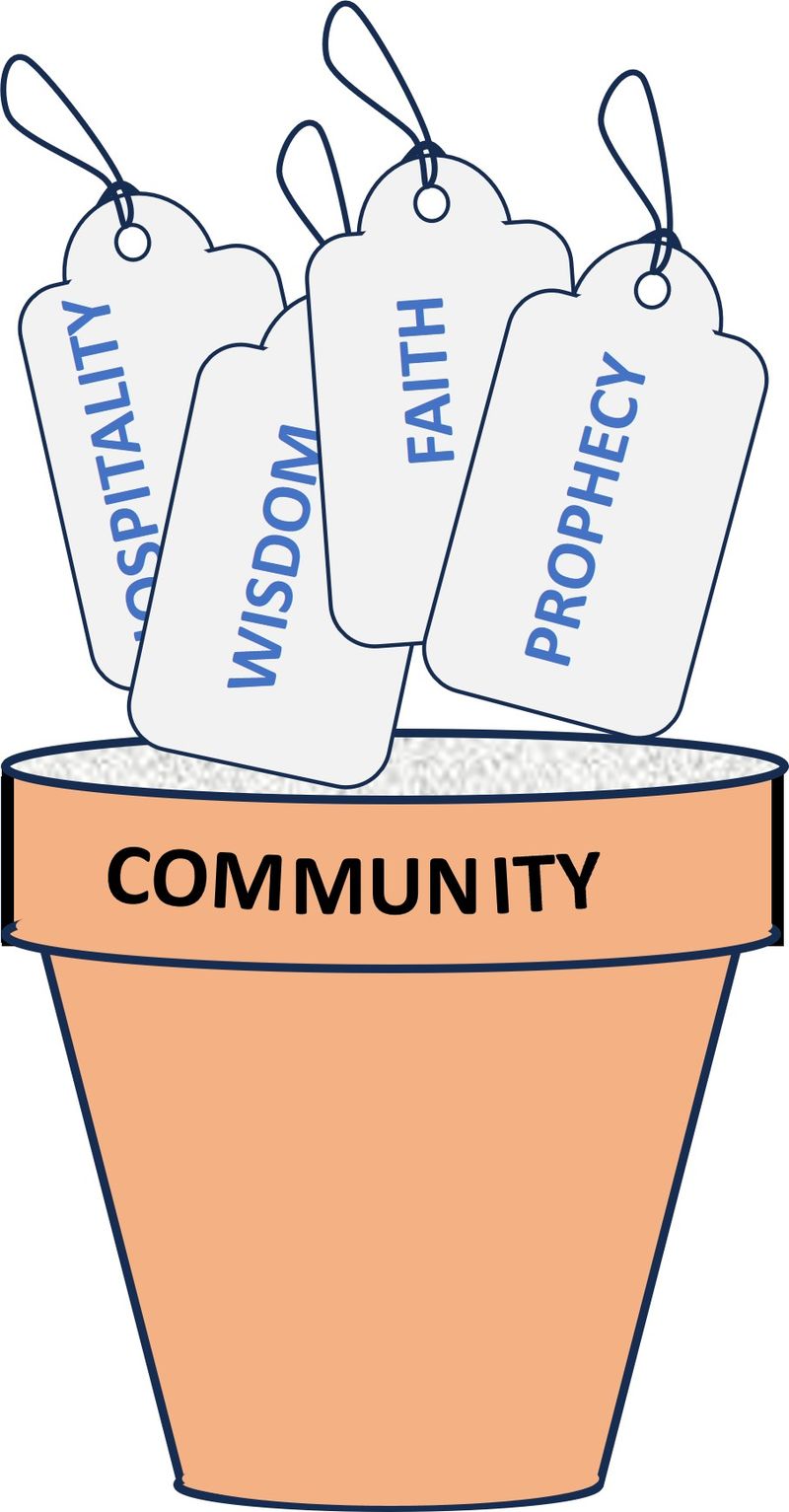
At another art station, Friends were each given a small clay flower pot to decorate. The tags went into their flower pot, representing the gifts “planted” by Spirit in their lives.
For our first workshop session, “How Do Gifts Build Community?,” we reviewed the types of Spiritual Gifts and the need to name, claim, and consecrate them – i.e. recognize them, own them, and offer them back to Spirit and community. We broke into small groups where each person was invited to share their Gift Tag and why they suspected they could name and claim this gift as their own. At the end of the small group time, participants were encouraged to consecrate their gift by “planting” it into a group flower pot with a blessing.
In the next session, “How Does Community Nurture Gifts?,” we shifted from “I” statements to “we” statements. In our small groups we considered what gifts our Meetings neglect, fear, or cluster. At the end of the session we read back the Gift Tags in our group flower pot and welcomed those gifts in our community: “Friends, these are our gifts! Do we accept these gifts? How can we nurture them?”
Reconvening, participants eagerly shared their experiences. Friends discovered many gifts held in common, though expressed differently. Friends also discovered that others held different gifts that complemented their own.
Several Friends recounted the profound experience of having someone else name their gift. Simply having names for gifts helped some. Many were struck by the power of the community accepting their gift. “Affirmation and appreciation are like water for the garden,” said one.
Friends laughed at how reluctant they first felt to name their gift… and then how reluctant they were to release gifts to the community flower pot!
Friends also realized that Meetings faced similar challenges nurturing Friends’ gifts. “The passion can get lost in the structure,” said one. “We say, ‘oh you do music?’ and then box you in.” “We deplete Friends by sticking them in slots *we* think should be filled.” There is a tension between filling committee slots and waiting on Spirit. We need to use the gifts we’re given but recognize and lay down things beyond our strength.
Friends also considered whether they bring the same Spiritual Gift to other communities – like work and family. Does how we do things express our gifts more than what we do? Some Friends felt their gifts were more accepted outside of the Meeting than within.
Several Friends were amazed to feel a call to Evangelism. “We as Quakers don’t often share our faith. We need courage to do so.” Friends were surprised and encouraged that some Friends could claim prophecy and miracles as their gifts.
But Friends were not at all surprised that they had named two new gifts: the Gift of Asking Questions and the Gift of Humor. Humor, Friends agreed, is truly a Spiritual Gift needed in community!
At the end, the community reconvened to “Receive Our Gifts.” We placed one large flower pot in the center of the circle. All the Gift Tags from the smaller pots were “planted” in this community pot. The most frequent Gift Tags were: Faith, Discernment, Helping, Humor, Music/Singing, Teaching, and Writing. We ended the workshop with a grateful closing circle.
Now, what about all those colorful dots?
Blue Dots: The gift that Friends felt we had most richly was Discernment, followed by Giving and Hospitality, then Faith, Prophecy, Teaching, Wisdom, and Writing.
Pink Dots: Friends overwhelmingly feared the gift of tongues! Perhaps more interestingly, Friends made clear they would not like to be call to administration and leadership, even more so than prophecy and evangelism!
Yellow and Orange Dots: Friends wanted gifts of knowledge and artistry, followed by faith, wisdom and miracles. Friends said we needed gifts of Leadership, Administration, and Music, followed closely by Faith, Healing, and Mercy.
Perhaps appropriately, “Faith” showed up equally as a gift that we have, we need, and we want.
St. Paul, writing to a community in Corinth where people had a hard time getting along, resorted to his metaphor of the body and its members to try to make clear his call for Unity. But it’s a strange kind of Unity – not based on conformity, but on diversity and interdependence. “The body does not consist of one member but of many. … If the whole body were an eye, where would the hearing be?”
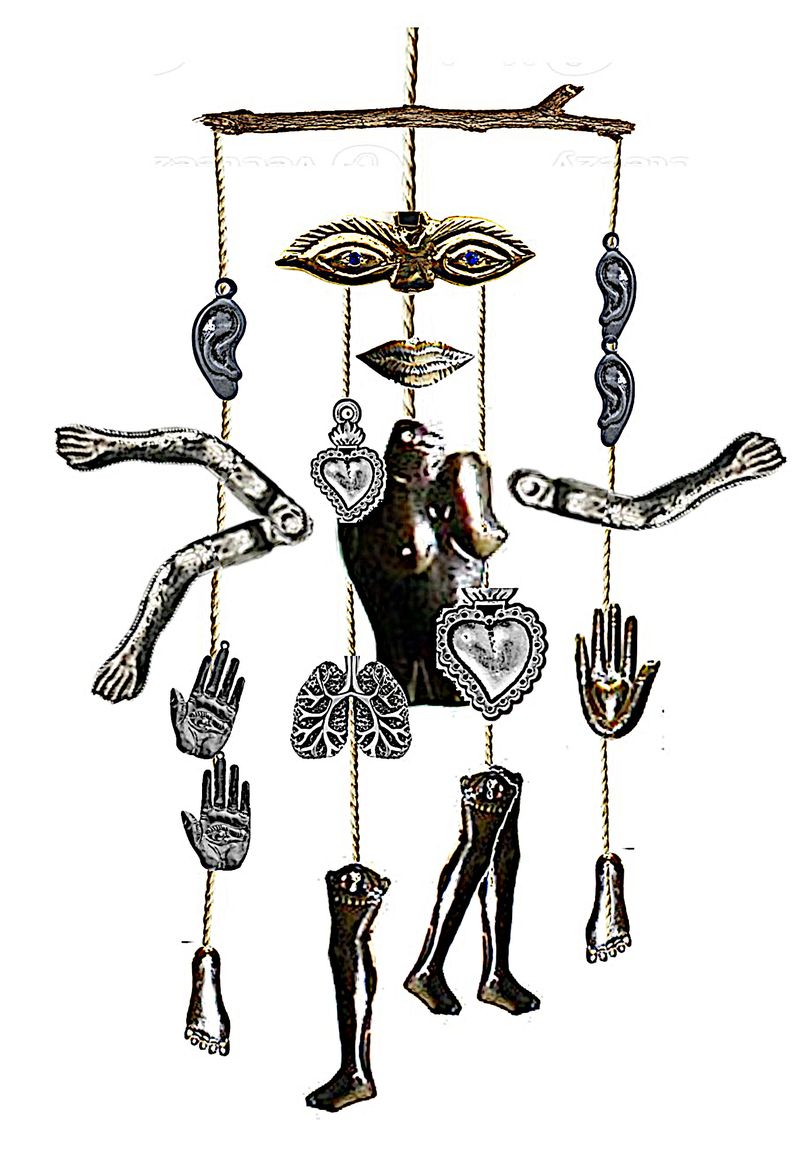
Here in New Mexico, small sacred healing sites often display milagros, little metal trinkets pinned as prayers, inviting divine attention to one part of the body – heart, hand, eye, etc... In the picture you can see the little spiritual body I’ve created with various milagro members.
How are our Meetings’ spiritual bodies? How are our hands, eyes, ears, and heart? Are we breathing well as we walk the talk? And what Milagro would best represent you and your gift as part of that spiritual body?
Rob Pierson is a graduate of the Earlham School of Religion and a member of Albuquerque Friends Meeting. He is a workshop leader among Friends and a recovering aerospace systems engineer. His interests span science and faith, Quaker interpretations of scripture, contemplative photography, and pilgrimage. He serves within Intermountain Yearly Meeting and the Friends World Committee on Consultation.